Workflows to Infection Prevention: The Invisible Threat in the Recovery Room
Lessons from a Year Without CAUTIs
In the quiet transition between the Operating Room and the PACU, a microbial rogue’s gallery often waits for an opening. While Escherichia coli is the most frequent offender, a deep dive into hospital data reveals a diverse threat profile including Pseudomonas aeruginosa, Klebsiella pneumoniae, and Serratia marcescens. These pathogens represent more than just data points on a dashboard; they are the architects of Catheter-Associated Urinary Tract Infections (CAUTIs), a complication that Ladhani et al. (2020) and Van Decker et al. (2021) identify as a primary driver of extended hospital stays and millions in preventable healthcare costs.
So here I was starting my Capstone Project partnering with Infection Prevention (IP). What was identified as I started was a challenge familiar to many high-volume facilities. Between 2022 and 2023, the hospital maintained a CAUTI rate of 0.71, with 8 infections recorded in 2023 alone. While their Standardized Utilization Ratio (SUR) of 0.55 suggested they were already outperforming many national benchmarks, the team refused to accept "good enough." The catalyst for change arrived in early 2024 with a multidisciplinary CAUTI Bootcamp. This intensive session shifted the focus from broad guidelines to the granular, often overlooked physical and communicative gaps in the surgical continuum. The question was no longer how to lower the rate, but how to reach and sustain a perfect 0.00 for an entire year.
Closing the Gaps: A Specialized Perioperative Workflow
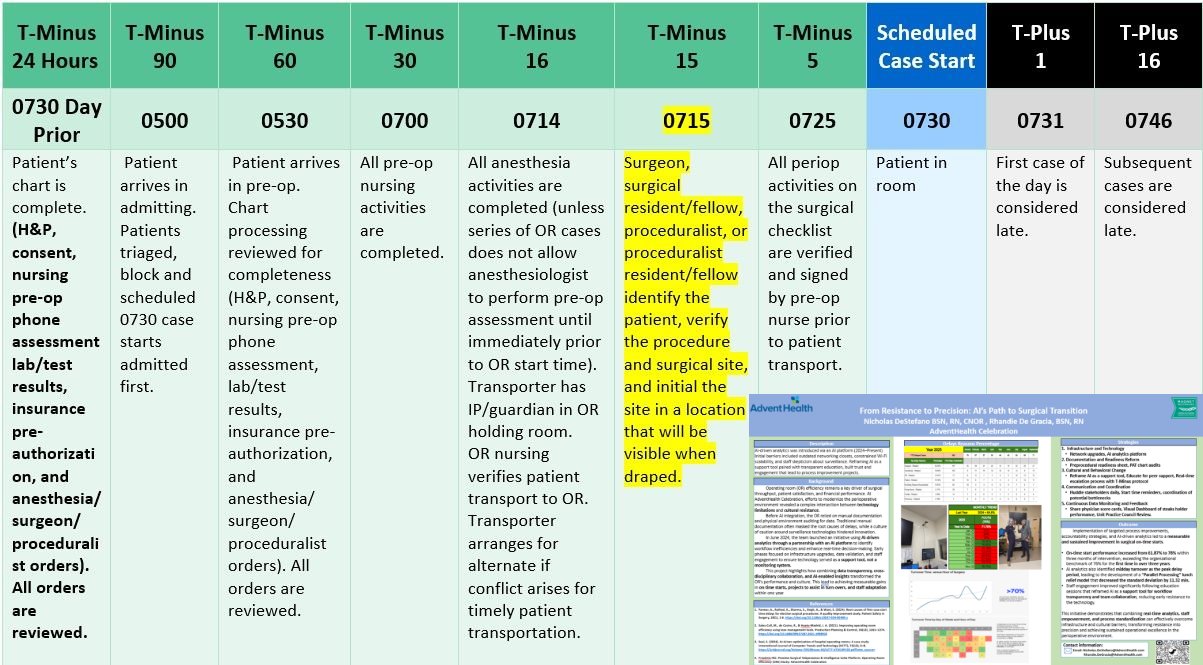
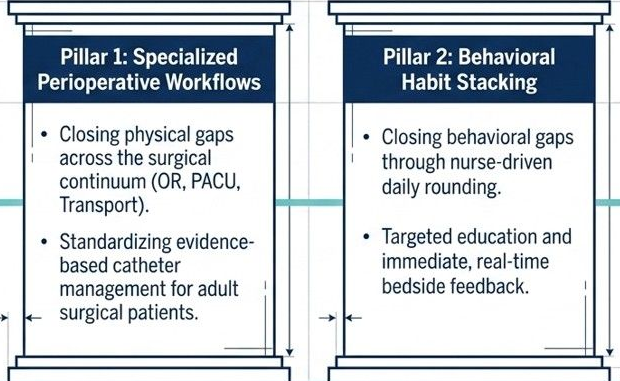
The success of my capstone began by identifying gaps across the entire surgical continuum from the Operating Room (OR) to the Post-Anesthesia Care Unit (PACU) and onto the inpatient floors. We realized that standard prevention strategies often missed the nuances of anesthesia-driven fluid managment and the risks inherent in patient transport.
We implemented several high-impact workflow changes:
- The OR Handoff: We reinforced appropriate Foley catheter insertion indications and improved critical communication between nurses and anesthesia providers.
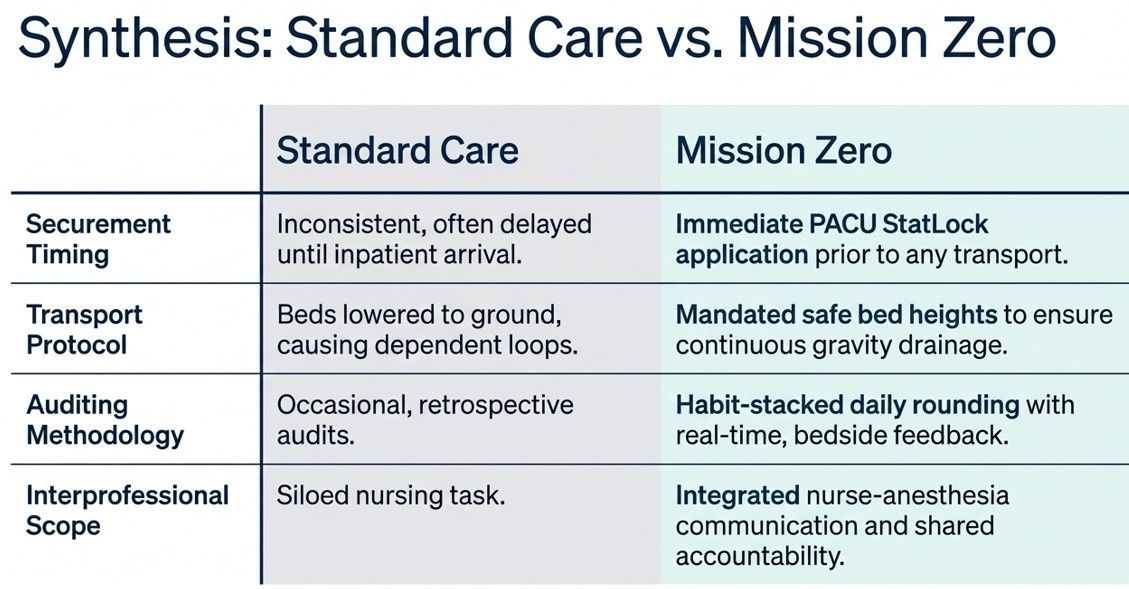
- Standardized Securement in PACU: We shifted to immediate securement using StatLock in the PACU, ensuring every patient was protected before leaving recovery.
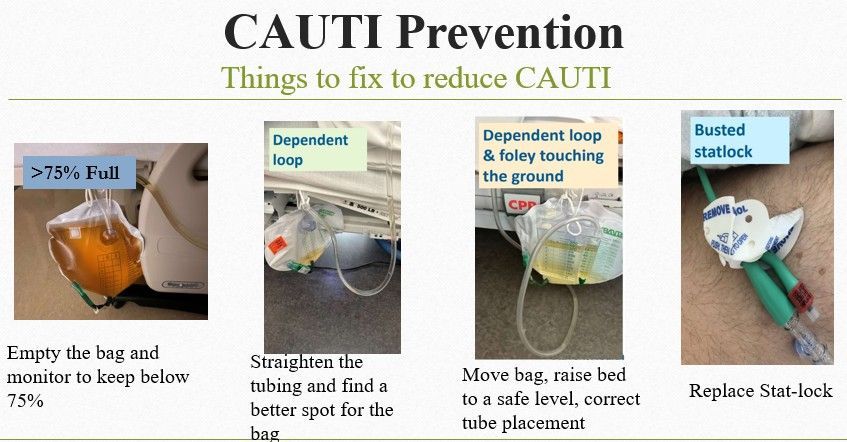
- The Transport Protocol: One surprising discovery was that lowering beds completely to the ground during transport led to catheters touching the floor. We implemented a new standard to maintain a safe bed height and ensure proper drainage bag positioning at all times.
The "Habit Stacking" Approach to Rounding
While education and training provided the foundation, nurse-driven rounding was the engine of our success. We moved away from occasional audits to a systematic rounding process that functioned like "habit stacking"—attaching CAUTI prevention checks to already established nursing routines.
By using rounding checklists, our teams turned a series of technical requirements into a single, cohesive habit. Every time a nurse entered a room for a routine check, they stacked these specific assessments:
- Catheter Necessity: Is the Foley still needed?
- The 75% Rule: Is the bag less than 75% full to prevent backflow?
- Positioning and Loops: Is the bag below the bladder and the tubing free of dependent loops?
- Securement Integrity: Is the StatLock intact and properly placed?
Real-Time Feedback and Interprofessional Culture
This wasn't just a nursing initiative; it was an interprofessional care bundle. We utilized "Hospital Lens" boards and flyers to keep prevention at the forefront of everyone’s mind. Perhaps most importantly, we implemented real-time feedback. When a deviation was found during rounding, it was corrected immediately, turning every audit into a teaching moment.
Results That Speak for Themselves
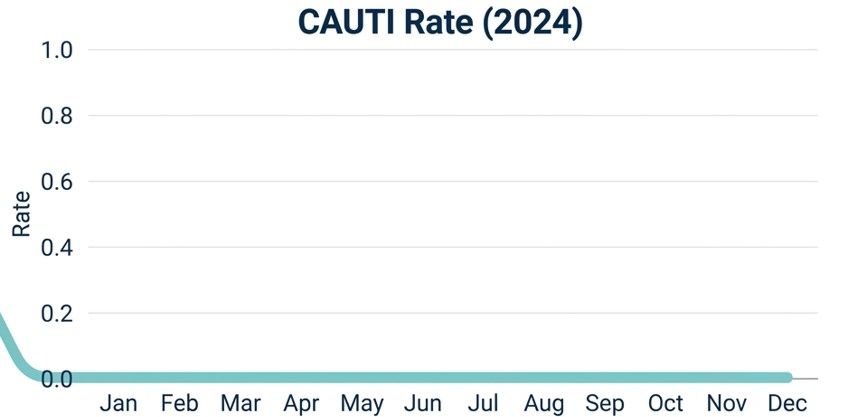
The impact of these workflow and rounding improvements was immediate and sustained. Our 2024 data shows a flat line at zero across every single month, proving that when evidence-based practice is integrated into the daily habits of a multidisciplinary team, "Mission Zero" is possible.
Through standardized practices and a commitment to meticulous rounding, we haven't just reduced infections—we've created a safer environment for every surgical patient who enters our doors.
Share