Nurse Burnout Prevention: The Human Algorithm | True Horizon Solutions
Nicholas DeStefano RN, BSN, CNOR • September 8, 2026
How Human-Centered AI Can Reduce Cognitive Burden Without Sacrificing OR Performance
Hi everyone,
my name is Nic and glad you stopped by to explore a human-centered approach to nurse burnout prevention that connects nurse wellbeing, workflow redesign, Microsoft Copilot, ChatGPT, and operational intelligence to reduce cognitive burden and improve healthcare.
Human-centered healthcare transformation begins by understanding both the people and the systems behind the metrics. This is what we will explore together in this blog.
What If Nurse Burnout Is Not Only a Resilience Problem?
Healthcare has spent years talking about nurse burnout through the language of resilience, wellness, self-care, work-life balance, and engagement.
Those conversations matter.
But after years of working across perioperative care, frontline nursing, trauma, critical care, and surgical leadership, I have come to believe we are often asking the wrong first question.
What if nurse burnout prevention was not only about building more resilient nurses, but building systems that require less unnecessary resilience?
Consider how much energy healthcare professionals spend every day navigating things that have little to do with the reason they entered healthcare.
Finding information. Reconstructing what happened yesterday. Searching emails. Following up on meetings. Waiting for an answer. Resolving a staffing issue that could have been identified earlier. Remembering which physician, procedure, patient disposition, or staffing pattern created a problem the last time the same conditions occurred. Responding to operational issues after the impact is already visible.
Individually, none of these tasks may seem extraordinary. Collectively, they create something different:cognitive burden.
And over time, cognitive burden becomes operational burden, leadership burden, andhuman burden.
Burnout is not always an individual failure to cope. Sometimes it is operational friction expressed through people.
How to Prevent Nurse Burnout Without Sacrificing Performance
One of the greatest false choices in healthcare is the idea that we must choose between the wellbeing of our people and the performance of our operation.
We do not.
In fact, the two may be more connected than we realize.
Poorly designed systems create both burnout and inefficiency. An incomplete process creates another phone call. A missing piece of information creates another interruption. An unclear responsibility creates another escalation. A late break creates frustration. A delayed turnover pushes the next procedure later. A staffing gap discovered too late becomes overtime, call burden, and pressure on the remaining team.
A manager who spends the first thirty minutes of every morning determining which emails actually require action has thirty fewer minutes available for people, patients, and operations.Lets be honest 30 minutes is an understatementto thehundredor so leaders get a day.
These are not separate problems. They are often different symptoms of the same system.
Innovation-led safety sits where AI automation, human connection, and operational performance intersect.
The Human Algorithm: Start With People, Not Platforms
Artificial intelligence is advancing at an extraordinary pace. Healthcare organizations are investing in Microsoft Copilot, ChatGPT, analytics platforms, automation, computer vision cameras, dashboards, and increasingly sophisticated data environments.
Buttechnology alone does not create transformation.
A license does not redesign a workflow. A dashboard does not guarantee awareness. A prompt does not create trust.AI does not automatically understand the operational reality of the clinicians expected to use it.
The Human Algorithm reverses the traditional technology-first approach.
Instead of beginning with, 'What can AI do?' begin with, 'Where are our people losing time, attention, energy, or trust?'
Stage
The Question
LISTEN
Where are people losing time, attention, energy, or trust?
MAP
What workflow or system is creating that burden?
AUGMENT
Can AI, automation, or better information design reduce it?
ADAPT
How will people experience the change?
LEARN
Did we return time, improve safety, improve life balance, or improve performance?
Technology should extend human capability, not displace human value.
LISTEN: Where Are Nurses and Leaders Losing Time?
The first mistake organizations can make with AI is beginning with the software.
·Where does frustration repeatedly occur?
·Where are people searching for information?
·Where do leaders repeatedly ask the same questions?
·Where is the team depending on memory?
·Where does a workflow require duplicate documentation?
·Where are spreadsheets being rebuilt every week?
·Where does the same problem surprise the organization over and over again?
·Where does the frontline feel the consequence of an operational decision made somewhere upstream?
The objective is not to find a reason to use AI. The objective is to find human friction worth removing.
LISTEN: Where Are Nurses and Leaders Losing Time?
The first mistake organizations can make with AI is beginning with the software.
• Where does frustration repeatedly occur?
• Where are people searching for information?
• Where do leaders repeatedly ask the same questions?
• Where is the team depending on memory?
• Where does a workflow require duplicate documentation?
• Where are spreadsheets being rebuilt every week?
• Where does the same problem surprise the organization over and over again?
• Where does the frontline feel the consequence of an operational decision made somewhere upstream?
The objective is not to find a reason to use AI.
The objective is to find human friction worth removing.
MAP: Find the System Behind Nurse Stress
Burnout often presents emotionally while originating operationally.
A leader may say, 'I do not have enough time.' A nurse may say, 'Every day feels reactive.' A team may say, 'Nobody tells us anything until the last minute.'
Those statements are important, but they are symptoms. The next question is: what is creating that experience?
Perhaps thirty minutes every morning disappear into email triage. Perhaps leadership handoff information exists across paper, Teams, Excel, email, and meeting notes. Perhaps staffing decisions require leaders to manually compare the schedule against case volume. Perhaps a turnover problem only becomes significant during lunch. Perhaps executives receive their monthly report only after a manager spends several hours compiling information from multiple sources.
Many healthcare organizations do not have a data shortage. They have an attention problem.
The information exists. The leader simply has to find it, reconstruct it, interpret it, remember it, and determine what to do next.
Where Nurse Burnout Actually Shows Up in the Workflow
The Inbox
A nurse leader begins the day with dozens or hundreds of messages. Some require an immediate decision. Some require delegation. Some are informational. Some contain a deadline buried three paragraphs down. The leader's first job becomes figuring out what deserves leadership attention.
The Meeting
A meeting ends. Everyone returns to work. The notes live in one place. The action items live somewhere else. Three weeks later, someone asks, 'Whatever happened with that?'
Staffing
Call-outs, vacation patterns, historical volumes, skill mix, case complexity, productivity, and anticipated demand all exist as data points. But the leader may still be manually reconstructing the staffing picture each day.
Operating Room Turnover
The department may have excellent first-case starts. Its actual bottleneck may occur between 1 PM and 3 PM when lunches, turnovers, staffing transitions, instrumentation, anesthesia demands, and room activity converge.
Executive Reporting
The information needed for an executive report already exists. The burden is gathering it, copying it, comparing it, explaining the variance, remembering what happened last month, and then rewriting the same story in PowerPoint.
Different problem. Same Human Algorithm.
How AI Can Reduce Nurse Leadership Cognitive Burden?
This is where tools such as Microsoft Copilot and ChatGPT become much more interesting.
• Triage email and surface what requires action.
• Summarize meetings and extract commitments.
• Prepare follow-up and recurring reports.
• Analyze operational data
• Summarize staffing information and identify patterns.
• Compare current conditions with historical events.
• Organize operational knowledge.
• Surface recurring barriers.
• Prepare a morning operational briefing.
Imagine beginning the surgical day with more than today's case schedule.
• House census: 90% occupied.
• ICU: one nursing call-out.
• PACU: approaching capacity threshold.
• Two scheduled procedures historically have a higher likelihood of ICU disposition.
• A similar combination of census, staffing, and procedural demand occurred three times during the previous six months.
• On two of those days, late-day bed constraints contributed to downstream surgical delays.
System Notifications
• Confirm critical care capacity.
• Review expected postoperative dispositions.
• Round with PACU leadership.
• Identify contingency placement plans.
• Review afternoon staffing coverage.
• Reassess cases most exposed to downstream bed constraints.
The AI is not the strategy. The redesigned workflow is the strategy.
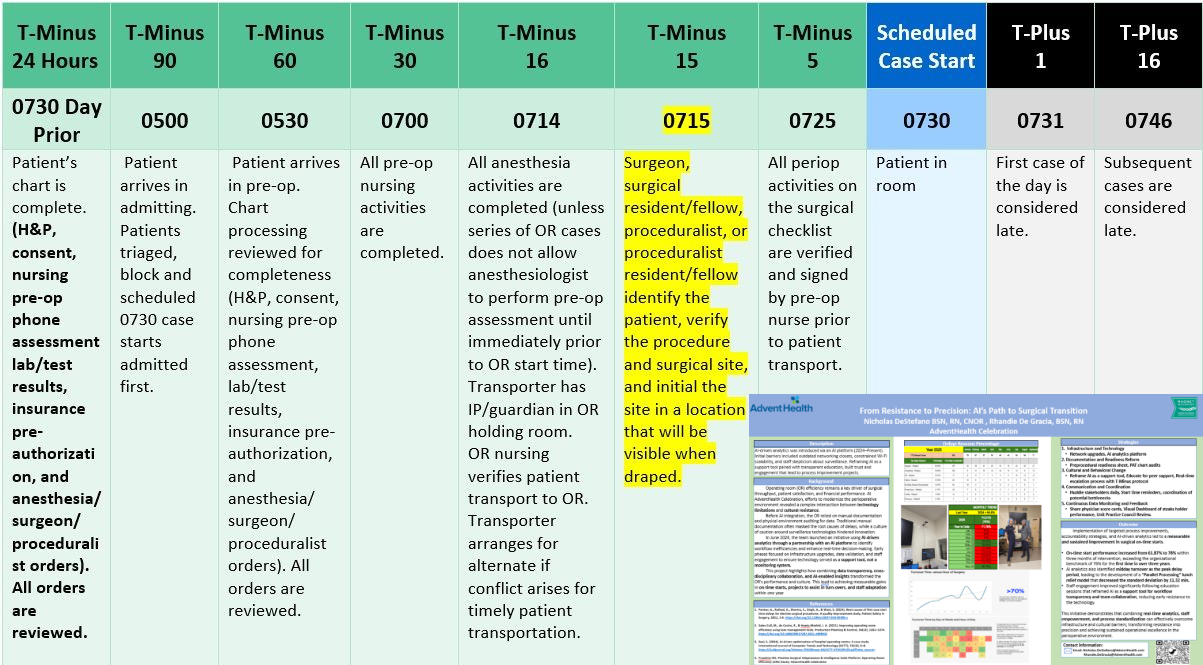
A structured T-Minus approach may move incomplete requirements upstream and prevent morning delays.
When the Problem Is Turnover
The right intervention may involve role clarity, parallel processing, staffing redesign, and better visibility into where transition time accumulates.
When the Problem Is Nurse Leader Cognitive Burden
The first intervention may simply be teaching leaders how to use Microsoft Copilot or ChatGPT to reduce inbox burden, summarize meetings, track follow-up, and prepare reports.
When the Problem Is Operational Awareness
The opportunity may be combining approved operational information into a daily briefing that surfaces known risk before the schedule begins to deteriorate.
The solution changes. The sequence does not.
What Nurse Wellbeing Looks Like at a Systems Level
If we are serious about nurse burnout prevention, wellbeing cannot live only inside wellness programs. It has to exist inside the operating system.
• Does our staffing model protect breaks?
• Does our workflow create unnecessary late stays?
• Does technology reduce searching or create another place to look?
• Do leaders receive information early enough to act?
• Are expectations clear?
• Can clinicians trust how operational data will be used?
• Do people have meaningful opportunities to grow?
• Does the organization learn from yesterday?
• Does the workflow return enough time and mental space for life outside of work?
The purpose of the Human Algorithm is not simply to make people feel better. It is to create a system where human wellbeing and operational performance reinforce one another.
What Nurse Burnout Prevention Looks Like in the Age of AI
The next era of nurse burnout prevention will require more than wellness programs. It will require us to examine the architecture of work itself.
Where does information live? Who has to search for it? Who has to remember it? When does leadership learn about a problem? Which administrative tasks actually require human judgment? Where is technology creating friction? Where could technology remove it?
And perhaps most importantly: what should clinicians and leaders be doing with the time technology gives back?
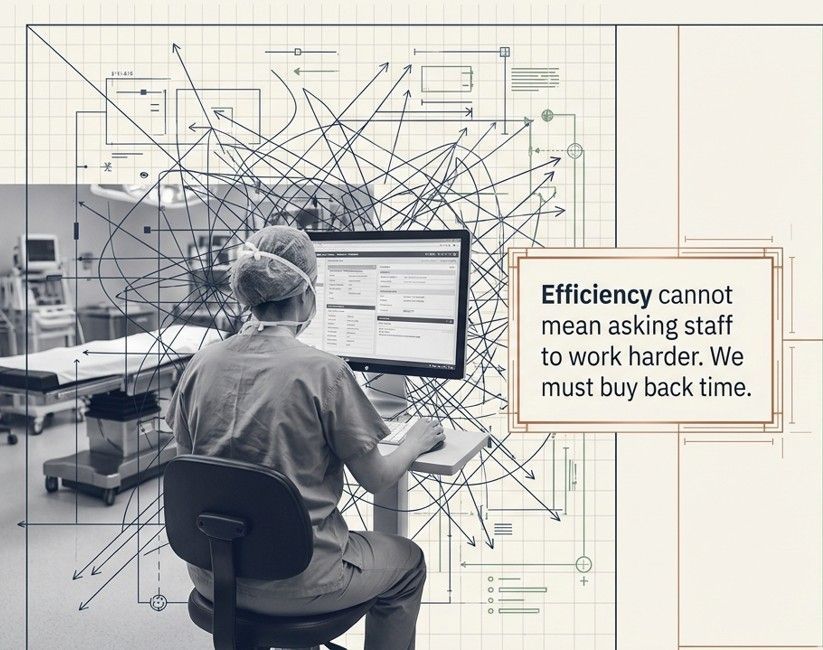
The answer cannot simply be more work.
• Patient care
• Staff development
• Leadership presence
• Rounding
• Coaching
• Safety
• Strategic thinking
• Recovery
• Human connection
• Family, personal priorities, and healthier life balance
Otherwise we have automated the task without changing the system.
Item Link
The
Leadership
Test
Healthcare leaders will soon have access to more AI capability than any generation before them.
The difficult question will not be: Can the technology do it?
The difficult questions will be: Should it? Will it help? Will people trust it? What burden does it remove? What new burden might it create? What does the human being get back?
Technology should remain subordinate to its purpose.
The purpose is not optimization for optimization's sake.
The purpose is creating an environment where clinicians can safely perform extraordinary work without forcing them to continually absorb unnecessary system failure.
Start with the human. Understand the friction. Map the work. Use technology intentionally. Manage the human response. Measure what comes back. Then learn from it.
Connect With True Horizon Solutions
Where is your organization asking people to carry a burden the system could carry for them?
And where are you, as an individual leader or clinician inside an organization, carrying work that could be redesigned so you have more attention for people, more control of your day, and more life left when the workday ends?
True Horizon Solutions works with bothorganizations and individualhealthcare leaders to identify workflow friction, make better use of tools they may already have, and design practical systems that reduce cognitive burden while supporting performance, wellbeing, and life balance.
Sometimes that means a larger operational redesign. Sometimes it begins much smaller: your inbox, your meetings, your reporting process, your staffing review, or the information you repeatedly have to find and remember.
If that question resonates, I would welcome the conversation.
Self-care is crucial for nurses, who often face long hours, high-stress environments, and emotionally demanding situations. Prioritizing self-care is not only beneficial for personal well-being but also essential for providing high-quality patient care. Here are key reasons why self-care is important for nurses.
Nurses are the backbone of the healthcare system, contributing in ways that extend far beyond basic patient care. Here’s why nurses are essential to the success of healthcare: